


SIMPLY IRRESISTIBLE: Saam Farahmand
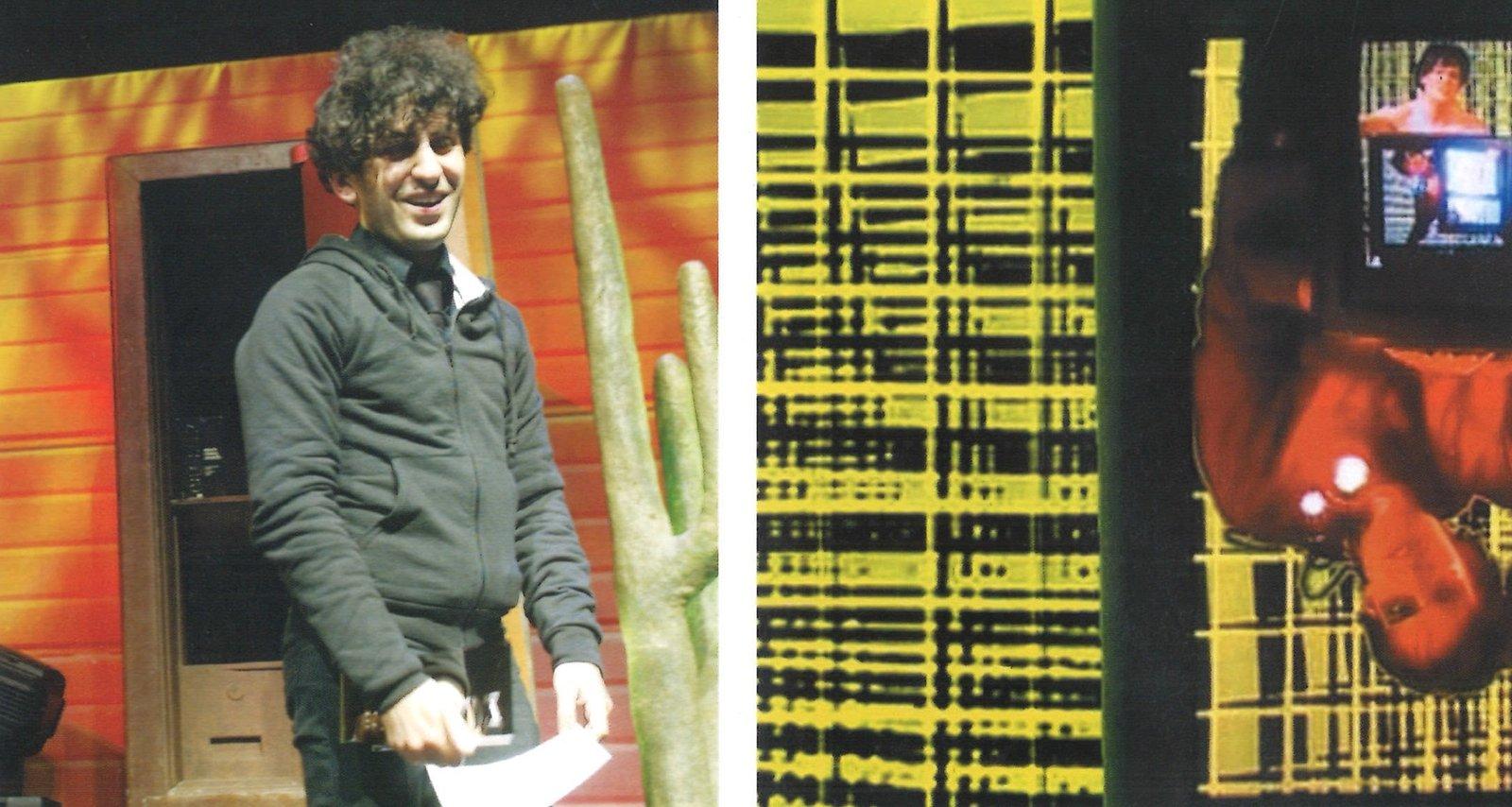
David Knight - July 2007
How did Saam Farahmand go from nowhere to best director of the year at the CADS in a matter of months? The answer, as David Knight discovers, is that he was an overnight sensation waiting to happen...
At the climax of the 2007 CADS, having displayed a distinctly theatrical reluctance to accept his honour, when he finally made it to the stage, Saam Farahmand nailed the moment in an outburst of nonplussed disbelief.
"This really doesn't make sense."
He had a point. Saam Farahmand – best director at this year's CADS ? Who would've thought that posible eight, seven, even six months ago? Only last October he was featured in Promo in a piece on Britain's rising wave of new directors. Now, only a few months later, here he is not only leapfrogging the new director category entirely, but edging out the likes of Dougal Wilson, WIZ and Patrick Daughters to win the Big One.
But despite his own apparent astonishment, was it really so surprising? The generous acclaim of an audience of his peers at the CADS told its own story. In a year where creativity in British music videos has gained a new momentum, Saam has been at its vanguard, arguably the outstanding exponent of this movement.
He has made videos for the coollest of the new bands of British music, sharing their vivacity and DIY ethic. He's played a big part in visualising a new music scene – the so-called New Rave – to the extent it's look is now regularly spoofed and lampooned. He's so close to his favourite bands he was strongly rumoured to be a member of the one with which he's enjoyed most success.
Most importanly, his work happens to be sexy, graphic, gorgeous, unexpected, and above all, original. His series of videos for his closest associates, Klaxons, is evidence enough of a very distinctive talent.
First there was the genuinely groundbreaking nearly no-budget video for Gravity's Rainbow – the one that arguably launched a new music fad/genre and inspired countless imitators: a dazzling unpredictable ride into infinity through TV screens. After his second Klaxons video for Magick, which placed that quickly distinctive 'new rave' fluorescent look in a horror context, there was the dramatic, hugely unexpected leap forward that was Golden Skans, where the band were transformed into ribbon-wearing demi-gods in an elemental, cosmic dimension.
Then came the second Gravity's Rainbow, the bigger budgeted remake and extension of the first one. And finally, It's Not Over Yet, another development of the Klaxons 'myth' established by Golden Skans – unabashed, unapologetic, highly stylised, beautifully produced fantasy, with more slow-motion smashing of unusual objects.
There have also been others for a slew of exciting new bands, including New Young Pony Club's Ice Cream, an extremely sexy video for Simian Mobile Disco's Hustler, and an ingenious one for Good Shoes' All In My Head. There was an out-of-leftfield understated outing for the Manics' James Dean Bradfield, and more recently the spectacular Golden Skans-ish pop gloss of Unklejam's What Am I Fighting For?
In short, Saam is the man. From what we've seen so far, he doesn't do narrative like anyone else, he doesn't do comedy, he's evidently not keen on band performance and he does not, like so many other directors, mine other film genres – with the exception, possibly, of old pop videos. He just happens to irresistably cool, and quite frankly, achingly hip. His work is stylish and stylised, overtly commercial and yet also utterly subversive.
In an industry where the conventions of the past, and the work of giants from a decade ago still cast a shadow, and where a combination of falling budgets and record label conservatism has stifled creativity, Saam Farahmand has (like others of this exciting new generation) arrived with a fresh vision, itching to ally it with his favourite music.
"Dougal and WIZ have probably done more well-rounded work in the past year, but I don't think there's been anyone as exciting and new as Saam in a long time," says John Hassay, MD of Colonel Blimp and freelance video commissioner. "He's probably the first person to emerge since the budgets came down. There's a big Saint Martins vibe at the moment, guys who are more overtly 'art school' than we've seen for a while – and he's the best of them."
Hassay is referring to the wave of directors that have emerged in the last year or so, mostly through leading production company Partizan, where music video executive producer Sasha Nixon and head of production Grace Bodie have nurtured a veritable hothouse of young talent including Nima Nourizadeh, Chris Cairns, Ollie Evans, Kinga Burza and Dan Lowe – the last two both nominated for best new director at this year's CADs.
Unlike most of this group – and its closeness professionally and socially is such that it could definitely be regarded as a 'scene' and quite possibly a movement – Farahmand did not attend Saint Martins, but he is most definitely 'art school': he went to Goldsmiths, where he studied fine art.
He stands out for other reasons, namely his unusual breadth of experience. Still in his twenties, Saam has followed a career pattern almost certainly unique among current video directors. These include working in television, as a director/producer at MTV2 and with comedy giant Armando Iannucci, devising live visuals, and as a fine artist. Splendid examples of this experience can be found on his own website www.saam.tv – from MTV2 idents to his extraordinary viral of George Bush and Tony Blair's addresses on Iraqi TV and a press conference being re-edited to become a horribly appropriate lipsyncing to Gay Bar.
Directing music videos is therefore merely Saam's latest career incarnation. But in fact it is something that he's been working at for some time, and it's only in the last year that things have come together so spectacularly. And that might explain his stunned amazement at the CADs.
I met Saam to discuss his work a few weeks before his big CADs surprise, and shortly after he and his Partizan colleagues have been celebrated for their "art rock" videos at Bug, the new music video event at the BFI Southbank, and interviewed, somewhat haphazardly, by comedian Adam Buxton.
At the time he was in post production with Klaxons' It's Not Over Yet, his fifth video for the band in a matter of months, and probably his most sophisticated yet. But from the start of our chat he is keen to emphasise his inexperience, his lack of achievement thus far, and the fact he is relatively unformed as a director. He even suggests that being interviewed by Promo is similar to a director like himself working with a new band.
"A band's identity – half of that comes from themselves and half comes from other people giving them an identity," he explains. "When I work with a band, maybe a new band with their first single, I have to figure out what is the essence of that person, give them a character. And in order to do journalism you don't always give them what is there."
In other words, how are you going to portray me? This is already getting interesting...
Well, for the record, Saam Farahmand is a 27-year-old Londoner of diminutive stature, with a mop of black curls above dark, expressive eyes. He has tremendous warmth, an old-fashioned gentle politeness which I'm tempted, quite possibly erroniously, to attribute to his background – his family is Iranian. In interview-mode he talks intensely, in scattergun bursts, with great feeling. He's effusive in complimenting others while declaring his dislike about talking about himself. He's self-deprecating, even self-dismissive. But there is, I suspect, an inner core of steely self-belief...
But following his Promo-editor-as-video director analogy – a new one on me, frankly – if the subject was a musical act, what does he think he'd be? "I'm probably a band that has just made its demo," he says. "A confused band and I'm waiting for the big producer to come in and pin me down."
To be honest, I find that bit difficult to swallow. But then again, it does fit with the picture of disbelief at the CADs witnessed a few weeks later. And undoubtedly things have all happened very quickly for him – after, it has to be said, a long period when it might not have happened for him at all. "Until a year ago it was all about me on my own," he continues. "This past year has been about me finally working with people. It's been a case of finding people that can take what I have been dreaming, and turn it into something I can actually see and touch. Before that I was trying to do it all myself."
That sense of ploughing his own furrow began properly when he was studying at Goldsmiths, where he often found himself at loggerheads with academics over his unapologetic embracing of popular culture – particularly movies and music videos. He started making cut-ups from movies like Reservoir Dogs and Eyes Wide Shut, and also did a presentation about the art of music video to his fellow students that simply enraged his course head.
Wasn't he inspired by his teachers at this prestigious school? "I was inspired by adverts and supermarkets, by the front cover of Hello, inspired by everything," he says
"I think what I like is things that are able to speak to a lot of people. Every artwork, film, music video is talking a language. The more personal that is, the less influenced by anything else it is, people see, can feel it's different. Because it's not speaking their language they can't really understand it, but maybe they just get a sense of it.
"What really excited me was with something like [Jon Glazer's video for Unkle's] Rabbit In Your Headlights, not only is there the feeling but also the craft – he'd used a language that the world can understand. I think the problem is, a lot of art is afraid to use that language because it often doesn't have the means to make itself as big as it wants to be. It has to speak in a mumble."
Saam has always loved commercials. He explains how as an eight-year-old he wrote his perfect, seven-minute Nike commercial – an array of different sportsmen, like a superhero team with different super-abilities, led by Mike Tyson, who have a big adventure. It sounds exactly like something that Nike have done since (without Big Mike, obviously). Conversely he says that his painting and sculpture at art school has influenced his videos. One art video he made, pouring vanilla syrup over someone's head for 25 minutes, sounds rather like the precursor to his Unklejam video.
He was clearly still immersed enough in the art world to start out as a fine artist once he left Goldsmiths. But having exhibited in group shows (it transpires that like alma mater Damien Hirst, at least one of these shows consisted of art all created by himself) he inveigled his way into MTV to show music head William McGillivray his 'art videos'.
Showing considerable chutzpah – and a taste for the dramatic – he says he simply turned up at MTV's Hawley Street office and "begged the security guard to let me in". It worked – and it was McGillivray who gave Saam his first big break. "I owe him so much," he says. "This was my first paid job out of college. Before that I was hanging coats up in Fabric and suddenly these guys were saying to me 'do whatever you want'. Here's a tape library with every music video ever made. This is pre-YouTube, right, 2002.... I had access to hundreds and thousands of tapes that I could call up at any point and flick through them. It was amazing."
At MTV, Saam made numerous idents for MTV2 which did so much to give the channel a far more distinctive feel than other music feeds, inside MTV or out. He also produced Zane Lowe's daily show Gonzo, but then he reveals he lost his job at MTV for what he describes as "all sorts of Zane-like stuff". But on the back of those idents – and particularly because of the viral he made of Bush and Blair lipsyncing to Gay Bar (a non-MTV job) – he found himself working with Armando Iannucci, and rubbing shoulders in script meetings with top comedy writers. Saam expresses more wonder and disbelief at his good fortune.
"That's how I met Adam Buxton. I'd be in a room with all these comedians, and there was Armando in the middle, the god of satire who I've worshipped since I was a child, and somehow I'm in this room and Armando is asking us to think of ways to fuck Gordon Brown, or dirty things we can make him say."
Consequently Saam made some astonishing cut-up videos where the President of the United States and then UK Prime Minister are swearing like... well, like they almost certainly do in private. But his skill as an editor – he says "I guess my main skill is editing" – means that it both looks and sounds like they are having a swearing contest.
But doing those cutups was a lesson in communication for me. It's like what I said before about using a language that people understand - that is a literal example of that, and that's why those things were so big. People need things that are familiar, a friend that talks to them."
Then there is his live visuals work – and another example of the Saam chutzpah. Having bought a projector, initially to project his artwork, he discovered a way of manipulating static TV signals by sticking wires into the aerial socket, so he endeavoured to use this technique to "play" visuals against live music.
"I wanted to make something that could respond to music instantly, because what I hate about visuals now is that a lot of people use these packages and they are not that responsive to the music," he says. "I wanted something that was not only responsive, but you almost have to know the songs to play it." A big fan of The Rapture at the time he again managed to blag his way into doing the visuals for the band at a record-store gig when they were touring the UK.
After that he created live visuals for Clor, Zongamin, and he also presented a show at onedotzero. During this period came the next crucial step: Saam was signed as a Partizan director in 2004, largely on the back of the Gay Bar viral. But then, for a long time, nothing really happened.
Sasha Nixon, who took over as music video directors' representative at Partizan shortly after Saam was signed, says there was a lot of acknowledgement of his ability among record-label commissioners, but not many takers. "It was a hard sell for a while," she admits. "Most people had seen the Gay Bar thing which they thought was great and very interesting, but the message was: 'come back when he's done something we can sell to the label.'"|
"You sometimes get into a situation with directors, however talented they are, that if you can't get them any jobs, it's better for everyone if they move on," says John Hassay. "I think that's what could've happened with Saam and Partizan."
What changed things was Saam's relationship with Klaxons, and certainly his first video for Gravity's Rainbow was the turning point – a breakthrough in more ways than one. Saam was good friends with Klaxons' Jamie Reynolds – they were in a band together, or something that resembled an art project, where they both played drums either side of a Roland 303 synthesiser playing loops. "We had this concept that both of us would drum on stage and there would be this huge projected entity that was going to command us. But we stopped. I was doing my videos and Jamie started the Klaxons."
Saam dismisses the idea that he was actually ever a Klaxons member, although when the band's first drummer left, he did apply for the job of replacement. "Much as I'd have loved to be their drummer I wasn't good enough,' he says, describing this failure as "heartbreaking." What he could do, however, was make the Gravity's Rainbow video.
With its ingenious single-shot movement in and out of TV screens, and fantastic art direction including crude green screen and lurid colours, Gravity's Rainbow was experimental, compellingly original and utterly influential: it effectively inspired the idea of new rave, a host of imitators, its own line in spoofs. It was also made for very little money – Saam produced it himself – but was also the start of him establishing firm ties with teamSTUSH – directors Chris Cairns, Dan Lowe, Ollie Evans and Anthony Dickenson, a group who invariably work on each other's projects and occasionally create work under the STUSH name.
"I didn't know about STUSH," says Saam. "I knew Dan and Ollie – Ollie had art directed one or two videos for me with absolutely no money. This had no money either, and I needed somewhere to shoot it. Chris said I could use his basement. I found myself surrounded by these really enthusiastic, sweet guys who loved what they did, stayed up to six every morning doing tests. It was one of the most intense videos I've ever been involved in. It was one of those rare things, and the STUSH army came to my rescue."
They have been close ever since – Saam enjoys honorary teamSTUSH membership, and they still help each other out – most notably on the video for Good Shoes' All In My Head where, with some STUSH help, Saam devised a lifesized zoetrope. They also appeared en masse in a viral version of Glazer's Jamiroquai video for Virtual Insanity that turns the famous long room in the video into a lavatory.
Was the crazy patchwork of ideas and techniques in Gravity's Rainbow as he intended? Is that how it's meant to look? "When you look at something like that and say it's really considered I think it loses something, but I think subconsciously I always knew what was going to happen at the end of it." he explains. "The fact that video got so much exposure... journalists from iD have said that video was the first thing that defined the new-rave aesthetic – the colours, the sensibilities – which is very flattering.
"I created that kind of video, and everyone wanted it. I was getting calls every week from new bands who wanted to be part of the new-rave circus asking me to make another of these videos. I'd explain that this is not what I do, I don't make this kind of video."
With hindsight, it's perhaps not surprising that following his Klaxons video for Magick, which expanded the day-glo idea, and toying with a horror/narrative theme of deadly contagion, that Saam should look to give the band a makeover. A few months on, the fully-fledged embracing of a commercial look has quickly become what many see as Saam's trademark style: he creates beautiful 'pop video' imagery with a sense of self-knowingness. But then, the cosmic theme and gorgeous pop glossiness of Golden Skans still came as a complete surprise.
"It was the only video I did that used a piece of language that the world was familiar with," he argues, referring to the clear parallels between Golden Skans and the Jacksons' classic Can You Feel It – actually closest in its use of sound effects. "That is my most seminal video, in that it's a good example of the difference between art and pop art."
He's followed that on clear developments of this theme. But his second, bigger-budgeted video for Gravity's Rainbow is also a direct development from the first. "I always thought it was shit when a band make a video that's raw, then they become successful and make another video. What I've never seen done is to actually remake the original video, in a way that reflects where the band are now."
In reflecting the re-recorded, better-produced track, he also added a further element: a 3D motion-control move, in the shape of the symbol for infinity. Also the girl who is dragged into the TV screen in the first version is eventually spat out again, back into her room, in the second. "That's her shaking, traumatised, at the end of the second video," says Saam.
Since then we've had Unklejam – more pure pop gorgeousness, as this other trio emerge from a primordial black gooey soup and neon – and now the latest Klaxons. It's Not Over Yet is also unexpected, but this time because it follows that Golden Skans template so closely: the three Klaxon members are sword-wielding cosmic Samurai defending a nest of tubes. Cue more delicious slow-motion sword-slicing and shattering, splintering spears. Pure film indulgence, in fact.
Is that where Saam is heading: into the pop-video big time? And then commercials? Perhaps not surprisingly he does say "I love advertising. Some adverts I saw were some of the most inspiring things. I don't think it's wrong, selling music... or even cigarettes."
As for videos, although budgets are not at the level that Jonathan Glazer could command for the likes of Rabbit In Your Headlights, Saam reckons that the challenge has changed anyway. "Then it was exciting to do something that was ethereal and violent," he muses. "I think what excites people has changed, and maybe it's more exciting to make a five-million-pound Justin Timberlake cinematic wankfest . That's probably more exciting to me now."
But then there is an unexpected analysis of his own work. "I definitely don't have a style yet," he claims. Most observers would disagree, particularly after his work in recent months. But maybe the likes of Golden Skans and It's Not Over Yet are just stepping stones to the next stage of achievement by Saam Farahmand. It's an intriguing thought.
"When I was just doing art I did a group show in which I made everything and all the artworks had made-up names," he recalls. "It was a joke, but now I'm thinking, was that because I don't actually know what it is I'm about? I think each of these videos is a tiny little step further to figuring out what it is I'm trying to say..."
Whatever Saam is about he can certainly be regarded as an "Artist", one with a sense for the dramatic. He's a protean talent – and under that slightly nervous, self-deprecating exterior he really does have steely self-belief.
What will he do next?
Now that is going to be interesting.
Saam of many parts
SAAM THE STUDENT
"I did a presentation [at Goldsmiths] where I showed the Rabbit In Your Headlights video, 'N Sync video for Pop, Gondry's Star Guitar, and then spoke for about 45 minutes about Mike Mills' three videos for his campaign for Air. Everyone on the course loved it, but the tutors flipped out, saying 'why do you still pursuing this weird Hollywood ad dream. Why are you abusing this space, what you've learned and what we've taught you?' It was weird. I was trying to show them that the work of Gondry and Glazer could be put in the same arena, and be given the same consideration they were giving to artworks..."
SAAM ON VIRALS
"I guess my main skill is editing, the kind of editing that I had to do [for the Gay Bar viral and other Bush/Blair cutups] is the kind that fries your brain. Seventeen hours of watching the same four-minute bit of footage forwards and backwards to find the right bit of lip movement. Like the one which turns what Bush and Blair are saying into a swearing contest, they are saying 'fucking cocksucker'. To make him say that I had to get the 'F' from function, the 'king' from United Kingdom.... it was literallly cut and pasted in the tiniest fashion you can imagine. Chris Morris did his Bushwatch thing replacing the odd word, and his was audio whereas mine was video. Having done the audio I had to trawl through the video again lookng for footage that looked like he was saying 'fucking cocksucker'. I don't want to go back to those days."
SAAM ON LIVE VISUALS
"I took my projector to this record store [where The Rapture were playing] and totally lied to them. I said 'I'm the visuals guy, where do I set up these TV things and projector?' The band and management came and freaked out. Everyone was like, you lied to us. I said, 'let me speak to the band'. The drummer of The Rapture saved me, he came over and asked what I did, I told him, and he said, 'alright, let him do it'.
So I projected behind them warping all these TV signals as they played live, and because I knew all the songs and the changes, I think that's what impressed them. Afterwards they asked me to do visuals for them. I kind of jumped the queue."
Featured on this page
Popular content
Feedback
Problem with this page? Let us know